

Palm Tree
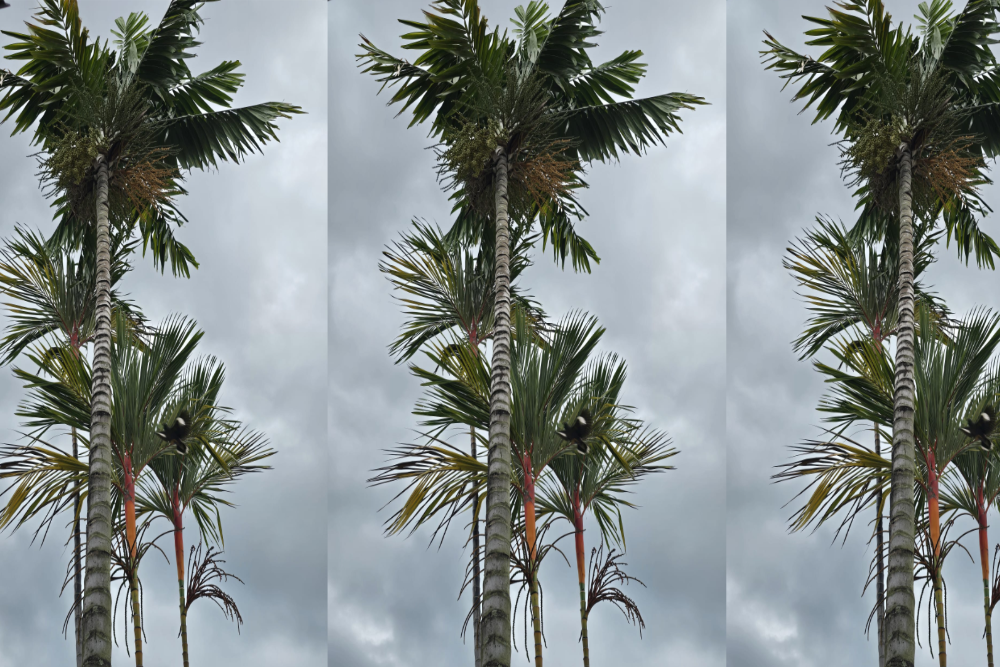
I look at the palm trees in the front and back of our home garden. Since these belong to the variety known as Lipstick Palm Trees, their trunks are red while the upper branches are green. When we were setting up our home, I had suggested planting palm trees like these, and my husband was quite surprised: “People plant banana, mango, jackfruit — what is this newfound obsession with palm trees?”
Well, banana trees do grow abundantly — but once the bunch of bananas drops, the tree must be cut down! The jackfruit tree sends its roots deep and can shake the very foundation of the house!
To everyone’s astonishment, the male palms in that temple bloomed with fruit-bearing bunches and transformed into female palms. Even today, one can see those fruit-laden palms there. Another fascinating practice can be found in the way ancient Tamils lived. “Madal etrudhal” was a custom of those times — when a hero wanted to win the heart of the woman he loved, he would perform this ritual to make his love known to the entire village. How? He would craft a horse from the broad fronds of the palm tree, ride it smeared in ash, wearing a garland of unplucked calotropis flowers, and call out the name of his beloved as he rode through the streets. This would happen only if the woman’s parents refused to accept him. Moved by his determination, the townspeople would witness the event and celebrate their marriage. So this rascal of a palm tree served even as a messenger of love!
Is the palm merely a tree? No — in those times, it was a livelihood for many, and their lives were profoundly woven together with it. In our home region of Chettinad, there are many palm trees — and many palm climbers too. The scars on their chests, left by the rough scales of the palm trunk, are embedded there like golden medals. Those majestic palms, I would say, are the very identity of Tamil Nadu. The path that winds through a grove of palms curves and twists like a great serpent… Peeling and curing the palm leaf, then etching words into it with a sharp stylus, required practiced skill and great strength. On a single strip of palm leaf, one could write at most six or seven lines. It is said that pressing the stylus firmly against the leaf while writing would wear away the fingerprints! If that is so, how much must the fingerprints have worn away on the hands of those great ones who wrote the Silappadikaram, the Thirukkural, the Kamba Ramayana, and all the other works of literature!
Even in Tamil proverbs, the greatness of this palm is evident: “Like a crow landing and a palm fruit falling” (used for coincidences)… “A fox in a palm grove is not afraid of the rustling”… “Like rain falling on a palm stump”… “Is the shade of a palm tree even shade? Is the companionship of an enemy even companionship?”… “A thousand palms to plant; a thousand coins in profit”… and so many more.
When I was a little girl, I used to sing a song about the palm tree, which comes back to me now:
“Palm tree! Oh palm tree! Why did you grow, oh palm tree?” “I shall tell you why I grew — listen well! I shall become the mat on which you rest; I shall become the hat that shades you from the sun! I shall become the firewood you chop; I shall become the material from which homes are built! To those who come hungry, I shall give the palm fruit! I shall give toddy to refresh the weary! In the summer heat of Chithirai, I shall offer the finest tender palm shoots! To the young men and women, I shall serve as the messenger of love! I shall come as a fan to wipe away your sweat! I shall drive away sorrow and help you build wealth!” Now do you agree — how remarkable the palm tree truly is! In summer, every tree serves all of us in every way — through flower, bud, unripe fruit, ripe fruit, root, branch, and leaf. But the question I leave with you, as I close this piece, is this: in what way are we, as human beings, supporting these trees without cutting them down?
— Banooravi (Singapore)